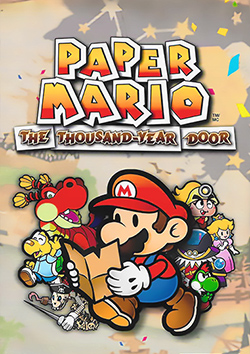
Badges, partners and battles
A starter guide to Paper Mario: The Thousand-Year Door: practise action commands, balance your level-up choices, use partner abilities in the field, review badges before bosses.
Original GameCube release; the Switch remake has changes not covered here.

Practise action commands
Timed inputs improve attacks and defence. Learn each partner’s action command instead of assuming every move uses Mario’s timing.
Balance your level-up choices
Level-ups let you improve HP, FP or BP. If a useful badge will not fit, more BP can expand your options; if you repeatedly run out of special attacks, consider FP.
Use partner abilities in the field
Partners solve different environmental problems as well as helping in battle. Revisit blocked routes when a new partner joins.
Review badges before bosses
Badge Points limit your equipped loadout. Remove badges that do not help with the next fight, and use the freed points for a relevant attack or defensive option.
Spend BP on a plan you can execute
HP adds survivability, FP supports special actions and BP opens badge combinations. If a useful badge does not fit, an extra HP level will not solve that particular limitation. Read the effect, compare its BP cost and consider whether the next fight makes it useful. Timed action commands and defensive inputs remain important even with a strong loadout, so practise a partner’s move instead of assuming its timing matches Mario’s.
Keep the three star resources distinct
Crystal Stars advance the main story, Shine Sprites fund partner upgrades and Star Pieces trade for badges. A discovery in one category does not automatically satisfy the other two. Revisit blocked field routes when a new partner joins, since a distant switch or concealed passage may need that partner’s specific skill. The optional Ms. Mowz recruitment is also separate from the partners supplied by the main chapter route.