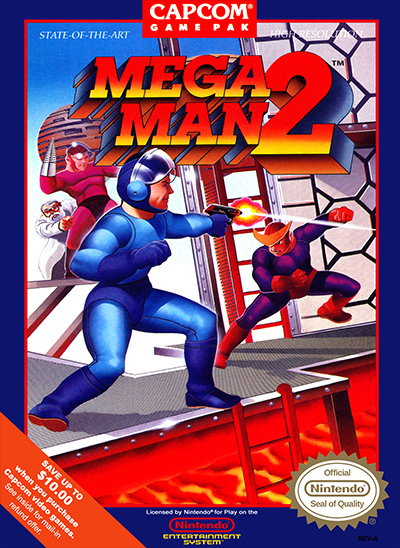
Four stages with different movement demands
Recognize the terrain before carrying a familiar strategy into a new stage.
Original 1988 Famicom / 1989 NES game. Guides use the English NES cartridge with Normal and Difficult settings. The Game Boy Mega Man II, remakes and later movement abilities are outside this reference.
Illustrated reference
Metal Man’s stage
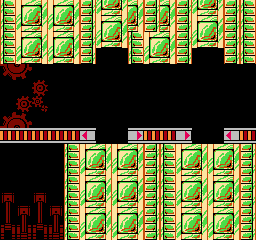
Conveyor machinery and industrial passages make horizontal positioning central to this route. Read the belt direction before jumping and keep a stable firing position.
Actual NES machinery from Metal Man’s stage; crop of a map assembled from original NES screenshots.
Air Man’s stage
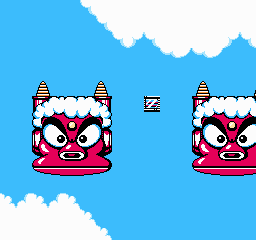
Open sky surrounds floating platforms and enemy footholds. Small landings and timed hazards make a patient observation of the next platform especially useful here.
Original NES Air Man stage pixels; crop of a map assembled from original NES screenshots.
Heat Man’s stage
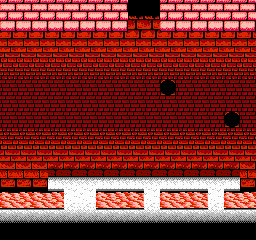
Brick-lined industrial terrain leads toward a demanding disappearing-block crossing. The Item-2 support platform offers an alternative after Air Man has been defeated.
Actual NES Heat Man stage scenery; crop of a map assembled from original NES screenshots.
Quick Man’s stage
Vertical rooms and a later laser gauntlet reward route memory and quick movement. Decide where to descend before a beam sweeps through the available opening.
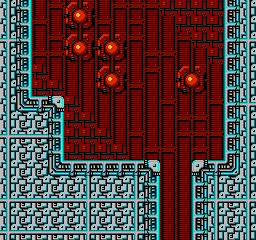
Actual NES Quick Man stage scenery; crop of a map assembled from original NES screenshots.
Respect the conveyor machinery
Metal Man’s stage asks you to combine shooting with movement on belts and around heavy machinery. A belt can change the distance of an approach, so pause before a jump whose landing is unfamiliar. Keep track of which direction the floor moves. The map crop below preserves the original machinery instead of substituting a picture from a different Mega Man title.
Treat the sky route as a platform problem
Air Man’s stage is defined by open sky and floating footholds. Watch the timing of a platform enemy’s hazards before jumping from one safe position to another. Holding a direction continuously can carry Mega Man past a small landing. In Heat Man’s stage, the disappearing blocks ask for another rhythm; Item-2 can simplify the long crossing once that support equipment is available.
Plan the descent through Quick Man’s stage
Quick Man’s laser rooms require a decisive route downward. Enter a new section with an idea of the next opening rather than stopping in the beam path to investigate it. Time Stopper can freeze the beams temporarily, but its energy is limited. Save or spend it according to the room you are learning, and keep enough awareness to move immediately when the effect ends.
A stage’s visual theme points to its main movement test, but every landing still needs a separate check.
Picture details
Game artwork belongs to its respective rights holders.