Advance Wars: Dual Strike Dual-front battles
Move reinforcements and manage the secondary map deliberately.
Edition covered
Original Nintendo DS game. Some archived screenshots use the Japanese Famicom Wars DS interface. Wii U re-release communication limits do not change the DS combat rules described here.
DS battles contain two battlefields
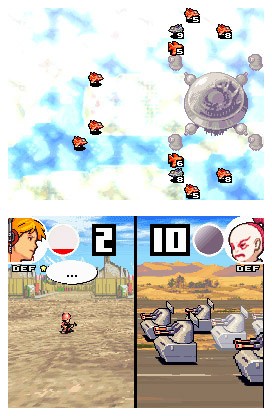
The top screen can hold a separate front rather than only information. Read victory conditions for both fronts before deploying.
| Option | Purpose | Practical use |
|---|---|---|
| Swap display | Inspect secondary front or intel | Check the other battle before ending a turn |
| Send | Transfer eligible units | Reinforce the front that needs help |
| Auto CO off | Manual secondary-front control | Coordinate exact attacks and movement |
| Auto CO on | CPU secondary-front control | Choose an appropriate AI strategy |
Send uses eligible properties
The Send command transfers a unit from the main front to the secondary front where the mission permits it. The destination and allowed units depend on that battle.
| Setting | General intention | When to inspect |
|---|---|---|
| General | Balanced behavior | Check whether it meets the specific objective |
| Defense | More defensive approach | Useful when preserving a position matters |
| Assault | Aggressive pressure | Make sure reinforcements can support it |
| Strike | Focused offensive behavior | Monitor valuable units and target progress |
Decide who controls the other front
Some maps allow the secondary front to be handled manually or by an allied CPU. Auto CO and the AI strategy setting are separate decisions.
Reinforce without abandoning the main map
A transferred unit no longer defends its original lane. Send enough to solve the second front while preserving captures and protection on the first.
References
| Reference | Website |
|---|---|
| Nintendo instruction manual | www.nintendo.com |