Read the castle’s changing terrain
Selected original rooms illustrate the castle approach, entrance hall and underground passages.
Original 1986 Famicom / 1987 NES Castlevania, using the North American cartridge rules. Famicom Disk System saving, later Castlevania movement and remake level layouts are outside these guides.
Illustrated reference
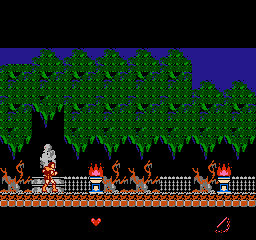
Castle entrance
The outdoor approach leads into Dracula’s castle and supplies an early place to practice the whip. Learn enemy spacing before entering the enclosed hall.
Actual original NES castle approach; crop of a map assembled from original NES screenshots.
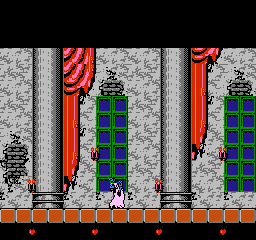
Entrance hall
The interior route introduces stairways and enclosed attack positions. Check the space behind Simon before striking, because knockback can change an otherwise safe encounter.
Actual NES interior hall scenery; crop of a map assembled from original NES screenshots.
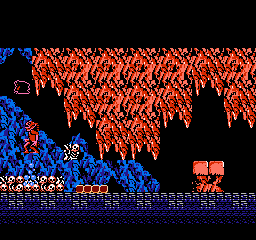
Raised cavern passage
Raised rock platforms interrupt the underground route. Choose the next landing before jumping, and keep the enemy on that platform visible while the whip extends.
Actual NES raised cavern passage in stage 10; crop of a map assembled from original NES screenshots.
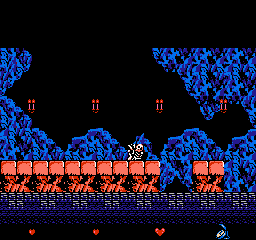
Cavern entrance
Rocky underground passages combine water, narrow footholds and enemies. Plan the landing first, then choose an attack that preserves room for the next safe movement.
Actual NES underground cavern scenery; crop of a map assembled from original NES screenshots.
Use the entrance to establish spacing
The opening castle approach and entrance hall provide room to learn the whip against ordinary enemies. Read the ground ahead before attacking a candle or stepping into a new threat. An open stretch is a good place to test a sub-weapon because a missed throw does not immediately force a difficult jump. Carry that learned spacing into the narrower interior instead of rushing simply because the scenery changes.
Treat stairs and platforms as commitments
Interior stairs limit the escape routes Simon can use during an attack, and raised platforms require a planned jump. Pause before a narrow landing and watch any flying enemy crossing its space. Simon’s knockback means that even a survivable hit can lead to a lethal fall. The castle’s stairs and tower passages reward choosing a stable position before the enemy arrives rather than trying to correct everything in midair.
Give underground water and moving hazards room
The underground route changes the visual rhythm to rocky passages, water and smaller footholds. Watch the landing and the enemy that can interrupt it as one combined problem. A safe attack on broad ground is often preferable to trading hits at the edge of a pool. Learn each short passage separately, then connect them into the level route after the next jump and escape space are predictable.
A hit’s knockback can be more dangerous than the health it removes.
Picture details
Game artwork belongs to its respective rights holders.