
Get comfortable with Sonic's momentum
Learn how running, rolling and rings work before chasing maximum speed.
Original 1991 16-bit Mega Drive/Genesis game. The Master System/Game Gear game is separate; later remaster moves, extra characters and Super transformations are outside this hub.
Run with a destination in mind
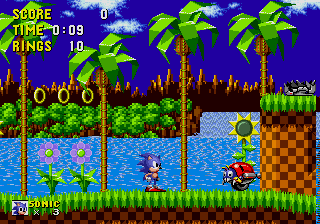
Use the directional pad to move. Sonic accelerates rather than instantly reaching his full running speed, and slopes affect the momentum you carry. A, B or C performs the Spin Jump on the original three-button controller. Start by learning a short stretch of Green Hill, then try it again with more speed. When you know the next landing, momentum helps; when you cannot see what follows, slowing down gives you time to respond. The first game's original cartridge does not have the sequel's chargeable Spin Dash.
Attack while curled into a ball
A jumping Sonic curls into his attacking form. Pressing down while moving sufficiently fast starts a rolling Spin Attack on the ground. These moves let you defeat many robots without taking a direct body collision. Springs, narrow platforms and enemy projectiles can still interrupt a careless route. Practice jumping onto a clear landing rather than merely jumping over the first obstacle. A running jump with too much speed can overshoot a small safe area, especially once the terrain changes from the open jungle.
Preserve a ring and use checkpoints
Rings protect Sonic from an ordinary damaging hit, which scatters the held rings instead of immediately costing a life. Recover a nearby ring if it is safe, then move away from the threat before trying to gather the rest. Touch a lamppost checkpoint to establish a restart point within the Act. Checkpoints support retries, but do not replace learning the obstacle that caused the loss. Treat a successful early run as preparation for Marble's lava and Labyrinth's water, where patience becomes as useful as speed.
Keep at least one ring when possible, and slow down before a landing you have not seen.
Picture details
Game artwork belongs to its respective rights holders.